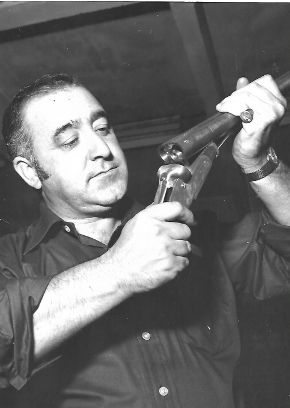
The question we are asked most often by owners is a simple one: how old is my gun? A side-by-side bought new by a grandfather, found at an estate sale or picked up from a dealer rarely comes with paperwork. The good news is that a Ugartechea usually tells you its age itself. Every gun made in Eibar went through the town’s proof house, the Banco Oficial de Pruebas, and from 1927 the proof house stamped a date code alongside its marks.
Where to look
Open the gun and take the barrels off the action. Turn them over and look at the barrel flats, the flat underside of the barrels at the breech end that sits against the action face. This is where the proof house put its stamps. You will usually find:
- The proof marks themselves: small crowned or shielded stamps showing the barrels passed proof.
- The gauge, often with the bore in millimetres.
- The chamber length in millimetres: 65 mm is 2½ inches, 70 mm is 2¾ inches, 76 mm is 3 inches.
- The barrel weight.
- A short letter code, sometimes with a small 1 or 2 after it. This is the year.
The action flats and the underside of the action often carry matching numbers. The maker’s name is usually on the rib or the lock plates: Ignacio Ugartechea, Eibar on older guns. Some guns built by Ugartechea were sold under other names, Parker-Hale in Britain being the best known. Those carry the same Eibar proof marks, so the method below works for them too.
Reading the date code
The Eibar proof house used the letters of the Spanish alphabet, one for each year, starting with A in 1927. The traditional Spanish alphabet treats CH, LL and Ñ as letters of their own and has no W, which is why those appear in the table. When the alphabet ran out, the sequence started again with a small 1 after each letter, and later with a 2.
So a gun stamped I1 was proved in 1963, and one stamped F2 in 1986. A plain E, with no number, means 1932.
| Letter | Letter alone | Letter + 1 | Letter + 2 |
|---|---|---|---|
| A | 1927 | 1955 | 1981 |
| B | 1928 | 1956 | 1982 |
| C | 1929 | 1957 | 1983 |
| CH | 1930 | – | – |
| D | 1931 | 1958 | 1984 |
| E | 1932 | 1959 | 1985 |
| F | 1933 | 1960 | 1986 |
| G | 1934 | 1961 | 1987 |
| H | 1935 | 1962 | 1988 |
| I | 1936 | 1963 | 1989 |
| J | 1937 | 1964 | 1990 |
| K | 1938 | 1965 | 1991 |
| L | 1939 | 1966 | 1992 |
| LL | 1940 | – | – |
| M | 1941 | 1967 | 1993 |
| N | 1942 | 1968 | 1994 |
| Ñ | 1943 | 1969 | 1995 |
| O | 1944 | 1970 | 1996 |
| P | 1945 | 1971 | 1997 |
| Q | 1946 | 1972 | 1998 |
| R | 1947 | 1973 | 1999 |
| S | 1948 | 1974 | 2000 |
| T | 1949 | 1975 | 2001 |
| U | 1950 | 1976 | 2002 |
| V | 1951 | 1977 | 2003 |
| X | 1952 | 1978 | 2004 |
| Y | 1953 | 1979 | 2005 |
| Z | 1954 | 1980 | 2006 |
A few things to keep in mind:
- The code is the year of proof, not of sale. A gun was proved when its barrels were finished, so it may have reached the shop months later, and occasionally a year or two later.
- Guns from before 1927 have no code. Ugartechea was founded in 1922, so the earliest guns have to be dated from their style and features.
- Stamps wear. After decades of cleaning, a 1 can look like an I and a small 2 can disappear. If the code doesn’t make sense, look at it under a strong light with a magnifying glass before deciding.
Guns made since 1995: the serial number
From 1995 Spain added the year of manufacture to the serial number itself, in four parts. The first part is the maker, the second the type of gun, the third the maker’s own number and the last two digits the year. Ugartechea’s maker number is 35, so a serial ending in -98 belongs to a gun made in 1998.
On these guns you can read the year straight from the serial number and use the proof marks to confirm it.
What the date tells you, and what it doesn’t
The year narrows down which models and features were being made, and it is the first thing an insurer, an auction house or a buyer will ask. It doesn’t tell you the grade, the original specification or what the gun is worth today. Those depend on the model, the engraving, the condition of the bores and the action, and any work done over the years.
Ask the workshop
If you can’t read the code, or the marks don’t match the table, send us clear photographs of the barrel flats, the action flats, the rib and both sides of the action, with the serial number. We will tell you what we can see.
For a gun that needs a proper record, for insurance, a sale or an estate, we also prepare written appraisals covering the date of manufacture, the specification, its condition and its value. The same workshop services and repairs older Ugartechea guns, and we still hold the factory drawings of the boxlock and sidelock actions.